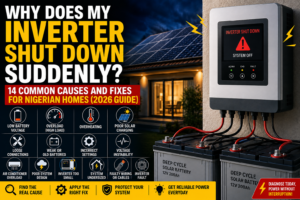
Few things confuse solar system owners more than seeing their inverter constantly switch between grid power and battery mode.
One moment, everything appears normal. The next moment, the inverter suddenly starts drawing power from the batteries even though public electricity is available. In some homes, this happens several times a day. In others, it occurs repeatedly throughout the night.
Besides being annoying, frequent switching can reduce battery lifespan, increase wear on electrical components, and leave homeowners wondering whether something is wrong with their solar system.
The good news is that this issue is usually caused by a handful of common problems. In this guide, we will explain why your inverter keeps switching to battery mode and what you can do to fix it.
How Inverter Switching Works
Hybrid and inverter systems are designed to automatically select the best available power source.
Most systems can switch between:
- Solar power
- Battery power
- Grid electricity
- Generator power
When everything is working properly, these transitions happen smoothly and only when necessary.
However, when certain faults occur, the inverter may switch unnecessarily or too frequently.
1. Low Grid Voltage
One of the most common reasons an inverter switches to battery mode is low incoming voltage from the utility company.
In many parts of Nigeria, grid voltage fluctuates significantly throughout the day.
For example:
| Voltage Condition | Result |
|---|---|
| 220V–240V | Normal Operation |
| Below 180V | Many Inverters Switch to Battery |
| Extremely Low Voltage | Grid Rejected |
Most modern inverters are designed to protect appliances from unstable electricity.
When voltage drops below safe limits, the inverter disconnects from the grid and powers your home using batteries instead.
Signs
- Frequent switching during evenings
- Lights dimming before switching
- Voltage warnings on inverter display
Solution
Install:
- Automatic Voltage Regulator (AVR)
- Surge protection devices
- Proper voltage monitoring
2. Incorrect Inverter Priority Settings
Many homeowners don’t realize their inverter settings determine when power sources are used.
Common operating modes include:
- Solar First
- Battery First
- Utility First
- Solar + Utility Priority
If the inverter is configured incorrectly, it may switch to battery mode even when grid power is available.
Review your inverter settings carefully.
Many users accidentally select Battery Priority during installation.
3. Weak or Unstable Grid Supply
Sometimes the voltage itself is acceptable, but power interruptions happen so frequently that the inverter continuously changes operating modes.
This is common in areas experiencing:
- Frequent outages
- Transformer faults
- Distribution problems
- Load shedding
The inverter is simply responding to the unstable electricity supply.
4. Battery Charging Problems
When batteries are not charging properly, strange switching behavior often follows.
For example:
- Batteries discharge quickly
- Charging remains incomplete
- Voltage becomes unstable
Homeowners experiencing this issue should first understand why solar batteries drain so fast because poor battery health frequently contributes to abnormal inverter behavior.
Warning Signs
- Reduced backup time
- Low battery warnings
- Inverter alarms
- Rapid battery percentage drops
5. Solar Charging Is Inadequate
Your inverter may switch to battery mode more often if the solar system is not producing enough energy.
Common causes include:
- Dirty solar panels
- Panel shading
- Poor panel positioning
- Damaged wiring
- Undersized solar arrays
If your batteries never reach full charge, review why solar panels are not charging batteries properly because insufficient charging is one of the most common causes of inverter switching problems.
6. Battery Bank Is Too Small
Many Nigerian homeowners underestimate battery requirements.
As household energy consumption increases, the original battery bank may no longer be sufficient.
This often happens when families add:
- Refrigerators
- Freezers
- Air conditioners
- Water pumps
- Additional televisions
Understanding how to calculate battery capacity for your solar system can help determine whether insufficient storage is causing the problem.
7. Loose Battery Connections
Battery terminals loosen over time.
Loose connections can cause:
- Voltage fluctuations
- Charging interruptions
- Unexpected switching
- Fault alarms
Inspect:
- Battery terminals
- DC breakers
- Cable lugs
- Battery interconnections
Even minor resistance can affect inverter performance.
8. Overloaded Inverter
When appliance demand exceeds inverter capacity, unusual behavior may occur.
Common overload appliances include:
- Air conditioners
- Electric irons
- Pumps
- Freezers
- Electric cookers
If your energy needs have grown, compare your setup using 1kVA vs 2.5kVA vs 5kVA solar systems to determine whether your current inverter is still appropriate.
9. Battery Voltage Settings Are Incorrect
Modern hybrid inverters allow users to configure:
- Low voltage cut-off
- Recharge voltage
- Float voltage
- Bulk charging voltage
Incorrect values may trigger unnecessary switching.
Improper settings are particularly common after:
- Firmware updates
- New installations
- User modifications
Always follow battery manufacturer recommendations.
10. Faulty Transfer Relay
Inside many inverters is a transfer relay responsible for changing between power sources.
When this component becomes faulty, the inverter may:
- Switch erratically
- Fail to recognize grid power
- Produce clicking sounds
A qualified technician may be required to diagnose relay problems.
11. Air Conditioners Are Draining Batteries
Many homeowners install air conditioners without upgrading the solar system.
Air conditioners consume far more electricity than most household appliances.
A single 1.5HP air conditioner can dramatically increase battery usage.
If your system powers air conditioners, review how to size solar panels for air conditioners in Nigeria because inadequate solar generation often forces batteries to carry more of the load.
12. System Was Not Properly Sized
Many inverter switching problems originate from poor system design.
A properly designed solar system balances:
- Inverter size
- Battery capacity
- Solar generation
- Household demand
When one component is undersized, instability often follows.
Homeowners should periodically evaluate their setup using a solar system sizing calculator for Nigerian homes to ensure the system still matches current energy requirements.
How to Diagnose the Problem Quickly
Use this table as a starting point.
| Symptom | Likely Cause |
|---|---|
| Switching during low voltage periods | Grid problem |
| Switching after sunset | Battery issue |
| Switching during heavy appliance use | Overload |
| Switching despite full batteries | Settings problem |
| Clicking sounds | Relay fault |
| Frequent switching during cloudy weather | Charging issue |
Preventing Future Switching Problems
The best way to prevent unnecessary switching is through proper maintenance.
Recommended practices include:
- Cleaning solar panels regularly
- Checking battery terminals
- Monitoring battery health
- Avoiding inverter overloads
- Reviewing inverter settings annually
- Installing voltage protection devices
Preventive maintenance is usually much cheaper than emergency repairs.
External Resource
The U.S. Department of Energy Solar Energy Guide provides additional information about solar power systems, battery storage, and residential energy management.
Frequently Asked Questions
Why does my inverter switch to battery mode when electricity is available?
The most common causes are low grid voltage, unstable utility supply, incorrect inverter settings, or battery-related problems.
Is frequent switching harmful?
Frequent switching can increase wear on batteries and electrical components over time.
Can low voltage cause inverter switching?
Yes. Many inverters automatically reject low-voltage grid power and switch to battery mode to protect appliances.
Can a weak battery cause this problem?
Absolutely. Weak batteries often create voltage instability that affects inverter operation.
Should I replace my inverter?
Not immediately. Most switching issues are caused by batteries, charging problems, grid instability, or incorrect settings rather than inverter failure.
Final Thoughts
An inverter that repeatedly switches to battery mode is usually reacting to an underlying problem rather than malfunctioning itself. Low voltage, weak batteries, poor charging performance, overload conditions, and incorrect settings account for the majority of cases.
Before replacing expensive equipment, take time to diagnose the actual cause. In many situations, simple adjustments or maintenance can restore stable operation and improve the overall performance of your solar system.