One of the first questions many Nigerians ask when considering solar energy is:
“How many solar panels do I actually need for my house?”
The answer is not as straightforward as most people think.
Two families can live in similar 3-bedroom houses and require completely different solar systems. One family may only need enough power for lights, fans, and a television, while another may want to run refrigerators, freezers, air conditioners, and pumping machines.
Installing too few panels can leave you struggling with power shortages. Installing too many means spending money unnecessarily.
This guide explains exactly how to calculate the number of solar panels needed for a typical 3-bedroom house in Nigeria.
The Short Answer
For most Nigerian 3-bedroom houses:
| Usage Level | Solar Panels Needed |
|---|---|
| Basic Usage | 4–6 Panels |
| Moderate Usage | 8–12 Panels |
| Heavy Usage | 12–18 Panels |
| With Air Conditioners | 15–24 Panels |
Assuming modern 550W solar panels.
However, your actual requirement depends on the appliances you use daily.
Why House Size Alone Doesn’t Matter
A common mistake is assuming that a 3-bedroom house automatically requires a specific number of panels.
Solar systems are designed based on:
- Appliances
- Daily energy consumption
- Battery backup requirements
- Sunlight availability
- Future expansion plans
A small family in a 3-bedroom apartment may consume less electricity than a large family living in a 2-bedroom flat.
That is why energy usage matters more than building size.
Step 1: Calculate Your Daily Electricity Consumption
Let’s use a practical example.
Typical 3-Bedroom House Load
| Appliance | Quantity | Wattage |
|---|---|---|
| LED Bulbs | 15 | 150W |
| Ceiling Fans | 5 | 375W |
| TVs | 2 | 250W |
| Refrigerator | 1 | 250W |
| Laptop | 2 | 130W |
| Decoder | 2 | 40W |
| Router | 1 | 15W |
Total Running Load:
1,210 Watts
Now let’s estimate daily energy consumption.
Daily Usage Calculation
| Appliance | Hours Used Daily | Energy Consumed |
|---|---|---|
| Lights | 8 Hours | 1.2 kWh |
| Fans | 10 Hours | 3.75 kWh |
| TVs | 6 Hours | 1.5 kWh |
| Refrigerator | 24 Hours | 2.5 kWh |
| Laptops | 6 Hours | 0.78 kWh |
| Router | 24 Hours | 0.36 kWh |
Daily Consumption:
10.09 kWh
Round up:
10 kWh per day
Step 2: Determine Solar Production
Nigeria enjoys excellent sunshine.
Most locations receive:
- 4.5 to 6 peak sunlight hours daily
For calculation purposes:
Let’s use 5 hours.
A single 550W panel produces approximately:
550W × 5 hours
= 2,750Wh
= 2.75kWh daily
Step 3: Calculate Number of Panels Needed
Formula:
Daily Consumption ÷ Daily Panel Production
10kWh ÷ 2.75kWh
= 3.64
After accounting for losses:
- Dust
- Heat
- Wiring losses
- Battery charging losses
You should add 25%.
Final requirement:
5 Solar Panels
This would handle the example above comfortably.
Solar Panel Requirements Based on Lifestyle
Basic Family Usage
Suitable for:
- Lights
- Fans
- TV
- Router
- Laptop
Recommended:
| Component | Quantity |
|---|---|
| 550W Panels | 4–6 |
| Inverter | 2.5kVA |
| Battery Storage | 5kWh |
Medium Usage Family
Suitable for:
- Refrigerator
- Multiple TVs
- Fans
- Home office equipment
Recommended:
| Component | Quantity |
|---|---|
| 550W Panels | 8–12 |
| Inverter | 5kVA |
| Battery Storage | 10kWh |
This is currently the most common setup in Nigeria.
Heavy Usage Family
Suitable for:
- Deep freezer
- Washing machine
- Pumping machine
- Multiple refrigerators
Recommended:
| Component | Quantity |
|---|---|
| 550W Panels | 12–18 |
| Inverter | 5kVA–10kVA |
| Battery Storage | 15–20kWh |
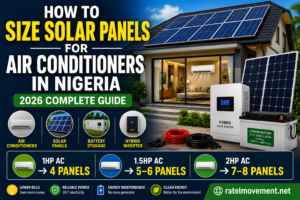
What If You Use Air Conditioners?
Air conditioners dramatically increase electricity demand.
Example:
1.5HP Air Conditioner
Average Consumption:
1,200W
Used for 8 hours:
1,200 × 8
= 9.6kWh daily
That is almost equal to the energy consumption of an entire basic household.
Solar Panels Needed for AC Usage
| Number of ACs | Additional Panels |
|---|---|
| 1 AC | 4–6 Panels |
| 2 ACs | 8–12 Panels |
| 3 ACs | 12–18 Panels |
This is why homes with multiple air conditioners often require larger systems.
How Much Roof Space Is Needed?
A typical 550W panel occupies approximately:
2.5 square metres.
Required roof space:
| Panels | Roof Space |
|---|---|
| 5 | 12.5 m² |
| 10 | 25 m² |
| 15 | 37.5 m² |
| 20 | 50 m² |
Most Nigerian 3-bedroom houses have enough roof area for these installations.
Should You Buy More Panels Than You Need?
Many experienced installers recommend slightly oversizing the solar array.
Reasons include:
- Future appliances
- Cloudy weather
- Battery charging efficiency
- System expansion
For example:
If calculations suggest 8 panels, installing 10 panels may provide better long-term value.
Common Mistakes Nigerians Make
1. Buying Based on House Size
A 3-bedroom house does not automatically require a specific solar system size.
Energy consumption matters more.
2. Ignoring Future Needs
Many homeowners later add:
- Air conditioners
- Freezers
- Water pumps
Designing for future expansion saves money.
3. Focusing Only on Panels
Solar panels are only one part of the system.
You also need:
- Batteries
- Inverter
- Charge controller
- Installation accessories
4. Choosing Cheap Components
Poor-quality panels often produce less power and deteriorate faster.
Frequently Asked Questions
How many solar panels do I need for a 3-bedroom house?
Most Nigerian households require between 8 and 12 modern 550W panels.
Can 6 solar panels power a 3-bedroom house?
Yes, if electricity usage is moderate and there are no air conditioners.
Is 5kVA enough for a 3-bedroom house?
For many families, yes.
A properly designed 5kVA system can comfortably power essential household appliances.
Can solar power my refrigerator all day?
Yes.
With adequate battery storage and proper system sizing, refrigerators can run continuously.
How many batteries do I need?
This depends on:
- Night-time usage
- Backup requirements
- Battery type
Most 3-bedroom homes use between 5kWh and 15kWh of battery storage.
Final Thoughts
For the average Nigerian family living in a 3-bedroom house, 8 to 12 solar panels of 550W each are usually enough to provide reliable electricity for everyday appliances.
However, the best approach is to calculate your actual energy consumption rather than relying on generic estimates.
A properly sized solar system will save money, reduce generator dependence, and provide stable electricity for many years.
Before purchasing any equipment, perform a load assessment or consult a qualified solar installer to avoid costly mistakes.